

On October 31st, URBRA joined stakeholders in the financial services sector to commemorate World Savings Day 2024. World Savings Day is an annual event to promote the importance of savings and financial literacy. It aims to raise awareness and foster a savings culture, and encouraging responsible financial practices among individuals and communities. World Savings Day was established on October 31, 1924, during the first International Savings Bank Congress (World Society of Savings Banks) in Milan, Italy.
The 2024 commemoration was spearheaded by a coalition of stakeholders led by Bank of Uganda, Uganda Bankers Association, and Uganda Institute of Banking and Financial Services. Other members comprised regulators of the financial services sector including Uganda Retirement Benefits Regulatory Authority (URBRA), Insurance Regulatory Authority (IRA), Capital Markets Authority (CMA) and Uganda Microfinance Regulatory Authority (UMRA.
This year, the day was marked under the theme: Sustainability and Personal Finance. All speakers emphasised that saving can only become a way of life if people are disciplined, committed and consistent. It was further observed that many people have personal finance goals and aspirations but these are often foiled by limited resources, limited skills and poor attitude towards saving. Thus, apart from cultivating the discipline and commitment, individuals also need to acquire the necessary skills, especially to match the technological developments in the financial service sector.
Addressing participants, the Executive Director, Uganda Bankers Association, Wilbrod Owor, observed that when it comes to saving, Ugandans now have a wide range of options to choose from – investment clubs, unit trusts, retirement schemes, SACCOs among others. Additionally, the scope of areas of investment has broadened, and people can now invest in sports, music, unlike in the past where there we just a few professions considered worthwhile. Owor further said that savers also have enhanced efficiency given the technological innovations and digitization.

“Generally, things have changed for the better; you can make a lot of money from different fields using different platforms. But as you make money, save for a rainy day. Regular flow of income can quickly come to an end, so have enough savings to fall back on in such eventualities,” Owor Said.
In line with the day’s theme, Owor said that savers must also think about sustainable investments and pointed out tourism as one of such areas which is eco-friendly and can easily subsidise other industry, as it speaks directly to environmental conservation. He warned citizens against assuming unsustainable debt and to guard against fraud. “While banks compliment savings with lending, you have to be careful about how much debt you take; don’t be overburdened by debt,” Owor stressed.
Further stressing personal commitment and discipline, the Executive Director of National Payment Systems in Bank of Uganda, Dr Tumubweine Twinemanzi, noted that the number of Ugandans saving had grown from 54% In 2018 to 60% in 2024. However, savings that are not invested come to naught. “The culture of saving exists but saving without growing those savings is akin to a man winking at a woman in the dark – only he knows what he is doing. Savings must go hand in hand with investment,” he emphasised. He challenged financial sector service providers to develop products and services or investable instruments that savers can apply to grow their savings.
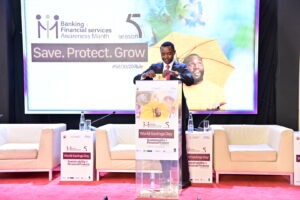
On sustainability, Dr Twinemanzi urged stakeholders to broaden their perspective beyond the environment. “We tend to restrict our view to environmental sustainability, but the concept is much broader. The essence of sustainability is to ensure that as you improve oneself, you don’t disenfranchise others. Personal development should be done in such a way that no one is made worse off by your actions,” he said.
Unpacking the real meaning of sustainability, Noah Owomugisha from Green Finance explained that the concept of ESG should be perceived comprehensively. Sustainability is the outcome of economic, environmental and social responsibility. At a global level, the Sustainable Development Goals (SDGs) provide a framework for sustainability. “Any investment that is not environment friendly or socially responsible is not good; similarly, any investment that is not characterised by good governance is not good,” Owomugisha said.
Above all else, investments and enterprises should thrive in regulated and supervised contexts. Thus, all financial services sector regulators were urged to ensure that the operating environment is conducive for investment, with the aim of enhancing public trust and confidence. In a regulators’ panel comprising representatives from URBRA, CMA, IRA and UMRA, it was generally agreed that enhanced personal finance and sustainability would largely boil down to public awareness and understanding of the key issues and options available.
URBRA was represented by Mr Benjamin Mukiibi, Chief Manager Research and Strategy who reassured the public that through its regulatory and supervisory roles, the Authority ensures once people decide to save, their funds are safe and prudently invested. He also said that mainstreaming sustainability principles in the retirement benefits sector is key, and all sector players are working in that direction.
The commemoration culminated in the launch of the fifth edition of the Banking and Financial Services Awareness campaign, which will run for a whole year, leading up to the 2025 World Savings Day.