
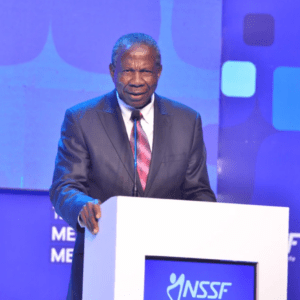
 The National Social Security Fund (NSSF) Annual Members Meeting is arguably the most anticipated event nowadays – not just in the Retirement Benefits Sector, but in the whole economy. This is understandable because many Ugandans have now come to appreciate what it means to save and watch their money grow year-on-year.
Many have also come to appreciate the importance of the AGM as a platform, not just for the announcement of annual interest, but for important member information. The proliferation of online platforms like Zoom, YouTube, X, and LinkedIn has also made it possible for more members to participate in the AGM, without geographical or time impediments. Gone are the days when people waited for the evening news, or for the next day’s newspapers to know the interest declared.
The 2025 AGM wasn’t different from the ones in recent years. The countdown to the D-day carried tidbits of what the fund had been doing throughout the financial year 2024/25. In a media dialogue on September 10th, the MD, Patrick Ayota announced the fund’s key achievements viz:
- The NSSF SmartLife Flexi, introduced in November 2024, had registered contributions worth over Ugx 27 billion in only 10 months.
- Customer satisfaction improved from 87% to 88% while staff engagement increased from 89% in 2023/24 to 91% in 2024/25.
- Member contributions increased by 10.4% from Ugx 1.93 trillion in 2023/24 to Ugx 2.13 trillion in 2024/25.
- The cost-to-income ratio dropped from 9.7% in 2023/24 to 7.9% in 2024/25, while the cost of administration reduced from 1.02% of total assets to 0.88%.
- Assets Under Management (AUM) increased by 17.5%from UGX 22.13 trillion in 2023/24 to UGX 26.0 trillion in 2024/25.
The impressive performance only heightened the buzz. “When are you declaring the interest on members savings?” netizens asked persistently – but the answer would only come with the Minister’s declaration on 22nd September.
On D-day, NSSF social media platforms came to life with thousands of participants logging in even before the set hour of 9.00am. They exchanged pleasantries and bantered about their expectations. They were from all over the country – Lira, Kitgum, Gulu, Entebbe, Kawuku, even Doha in Qatar. The excitement was almost tangible – and it would soon be rewarded.
It wasn’t long before a message from NSSF came through: “Good morning everyone, we are delighted to have you here. Catch the event live across all our social media platforms and on television as we take a deep dive into the Fund’s journey looking back at the past year, celebrating current milestones, and future plans. We are live on UBC, NBS and NTV.” That captured the magnitude of the event and the breadth of its reach. 3 URBRA Newsletter FY 2025/26
The Auditor General’s report was as curt as it ought to be: “In my opinion, the accompanying financial statements present a true and fair view of the Fund as at 30th June 2025 and its financial performance and cash flows for the year ended in accordance with the International Financial Reporting Standards and in the manner required by the NSSF Act Cap 230,” James Bantu, Assistant Auditor General read out.
The Managing Director, Mr Patrick Ayota, presented his report highlighting the impact of the fund on the economy in form of contribution to GDP, investment in local companies and real estate, as well as job creation to the tune of 1.8 million. He emphasized that saving for retirement is more about discipline than the amount of money one has. He assured members that the fund remained committed to preserving the value of their savings by always paying interest that surpasses inflation.
In the same spirit, the Chairman NSSF Board of Trustees, Mr David Ogong, likened the NSSF to the servants in the parable of talents (Matthew 25:14-30), who invested their master’s money with the bankers and brought him good interest. He assured members that they would all be happy with the interest the Minister was about to declare.
Mr Ogong further reaffirmed that NSSF was ready and willing to invest in infrastructural projects if such bonds were created saying, “NSSF members are the ones who suffer in traffic jam, yet we could use our funds to invest in highways.” He expressed gratitude to the government for opening up the fund to extend coverage to informal sector workers and mentioned that their ambition was to cover 50% of the working population.
The Minister of Gender, Labour and Social Development, Hon Betty Amongi, thanked employers for complying and Ugandans for trusting NSSF with their life savings saying, “your trust is not misplaced.” She was particularly proud of the performance of the NSSF SmartLife Flexi product, which has attracted over 39,000 savers in just ten months. “Our ambition is to increase members from both formal and informal sector and we shall do anything to enable them save with NSSF, while maintaining strong oversight and corporate governance,” Amongi reaffirmed before inviting Minister Kasaija to perform the most exciting part of the meeting.
Hon Kasaija did not sustain the suspense for too long. Visibly excited as he read the fund’s outstanding achievements of Financial Year 2024/24, Minister Kasaija took time to reflect on the interest rates he had declared over the past five years with 12.5% in 2020/21; 9.65% in 2021/22; 10% in 2022/23 and 11.5% in 2023/24. But clearly, the audio-visual technician was even more excited because he (or she!) flashed the interest as the Minister was still reading statistics from previous years. The Minister’s speech was momentarily drowned by jubilation, and he resignedly said, “the secret has already been let out!” Yes, it was 13.5% – the highest interest rates paid to members in NSSF’s recent history!
Notwithstanding the celebration, members took the opportunity to ask questions, air their concerns and make recommendations on how NSSF can improve. Many asked about the calculation of interest which didn’t seem to match their current balance.
NSSF explained that interest is paid on balance as of 1st July of the previous year. Others requested NSSF to start extending loan facilities to members and to construct affordable houses which members can purchase using their accrued benefits. As usual, there were rants about the age of access to benefits with the argument that it should be reduced from 55 to 40. Some members complained about non-remittance of savings by employers and NSSF encouraged them to use the whistleblower provision. Other members recommended that NSSF should open to university and secondary school students, to enable them to start saving early.
Around the same time next year (2026), NSSF will be declaring interest on members’ savings for financial year 2025/26, basing on their balances as of 1st July 2025. Time, consistent saving, and factors in the broader economic context will tell how exciting the next AGM will be.