

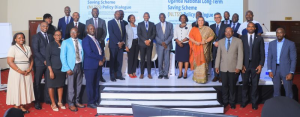
 On 20 November 2025, the Uganda Retirement Benefits Regulatory Authority (URBRA), in partnership with the Ministry of Finance, Planning and Economic Development (MoFPED), Universal Pensions, and the Resource Enhancement and Accountability Programme (REAP), convened a National Long-Term Saving Scheme (NLTSS) Policy Dialogue at the Kampala Serena Hotel. The engagement brought together policymakers, regulators, pension institutions, development partners, digital innovators, and informal sector representatives to assess Uganda’s readiness to roll out a national retirement savings solution for informal sector workers.
Held under the theme “Laying the Foundations for Mobilising Long-Term Savings from Informal Sector Workers in Uganda,” the dialogue addressed a critical policy gap: while the informal sector constitutes about 84 per cent of Uganda’s workforce, the majority remain excluded from structured retirement savings yet face increasing life expectancy and extended post‑retirement survival needs.
Opening the dialogue, URBRA’s Accounting Officer, Ms Rita Faith Nansasi Wasswa, underscored the urgency of establishing sustainable long‑term savings mechanisms. She noted that many informal workers are likely to depend on personal savings for nearly 20 years after exiting active work. Ms Nansasi informed participants that URBRA had obtained a no‑objection from the Permanent Secretary/Secretary to the Treasury to collaborate with development partners through a regulatory sandbox framework to operationalise the NLTSS. She reaffirmed URBRA’s commitment to a sound regulatory environment anchored in the URBRA Act and commended the support of MoFPED, Universal Pensions, FSD Uganda, APSA, the World Bank, and URBRA staff, urging stakeholders to champion the scheme nationally.
In his keynote address, the Minister of Finance, Planning and Economic Development, Hon. Matia Kasaija, highlighted the growing challenge of old‑age poverty. He observed that only about four million Ugandans are covered under formal retirement arrangements, leaving farmers, traders, daily wage earners, and domestic workers largely unprotected. He further noted that Uganda’s elderly population is projected to rise from 2.3 million to 5.4 million by 2050, which could create fiscal pressures if long‑term savings mechanisms are not strengthened. The Minister emphasised that securing dignity in old age is central to Uganda’s socio‑economic transformation and outlined the NLTSS objectives of enabling informal workers to save for retirement while mobilising long‑term domestic savings to support the Tenfold Growth Strategy.
The first technical session examined the rationale for NLTSS within national development. Mr Benjamin Mukiibi, URBRA’s Chief Manager Research and Strategy, presented a situational analysis of the retirement benefits sector, highlighting challenges faced by informal workers, including irregular incomes, emergency‑driven spending, and exclusion from pension products. Drawing lessons from Rwanda, India, Mexico, and Kenya, he noted that Uganda is ready for a centralised, government‑supported digital savings model that combines long‑term pensions with short‑term liquidity and complementary insurance. Such a model, he argued, would both reduce old‑age vulnerability and mobilise domestic savings for development financing.
Panel discussions emphasised that NLTSS must be simple, flexible, and trustworthy, supported by clear, relatable communication. Participants underscored the importance of tailored approaches for women, farmers, and other occupational groups, community‑based champions, and inclusive technology solutions such as USSD, agent‑assisted onboarding, and easy balance enquiries. Global perspectives from APSA and international practitioners stressed that Africa’s low pension coverage—estimated at below 10 per cent—makes voluntary micro‑pension schemes essential, particularly for young contributors with flexible saving patterns.
Discussions on ecosystem readiness highlighted Uganda’s strong foundations for implementation. MoFPED noted that the pension sector contributes over 60 per cent of gross national savings and about 13 per cent of GDP, making it a pillar of economic growth. Studies by FSD Uganda and the World Bank recommend shared digital infrastructure governed by URBRA to ensure transparency and scalability. Financial and technology partners, including Centenary Bank, Universal Pensions, NIRA, MTN Mobile Money, NITA‑U, and SBG Securities, demonstrated readiness to support secure onboarding, interoperability, fraud prevention, prudent risk management, and seamless mobile money integration.
The dialogue also underscored the role of Government and development partners in driving mass adoption. With 81 per cent of Ugandans already financially included through banks or mobile money, participants noted strong potential for rapid uptake. The Bank of Uganda shared ongoing financial literacy initiatives, while speakers highlighted the role of incentives—such as tax benefits, onboarding bonuses, and bundled benefits—to accelerate participation, recommending pilot testing of different models.
Closing the dialogue, Mr Moses Kaggwa, Director of Economic Affairs at MoFPED, linked NLTSS to the Tenfold Growth Strategy, which aims to grow Uganda’s economy from USD 50 billion to USD 500 billion by 2040. Achieving this ambition, he noted, will require increasing domestic savings from 21 per cent to 40 per cent of GDP. While financial inclusion stands at 81 per cent, only 16 per cent of the workforce has formal retirement coverage. He commended URBRA for leading the NLTSS initiative and reaffirmed Government’s commitment to supporting its rollout through digital delivery, targeted incentives, enhanced financial literacy, and strong accountability frameworks.
The dialogue concluded with agreement on next steps, including finalising PensionTech procurement, completing business process reengineering, signing service‑level agreements with implementation partners, and implementing a comprehensive change‑management strategy.The NLTSS pilot will test integrated benefits combining micro‑pensions, micro‑insurance, and emergency micro‑savings, supported by community‑led financial literacy campaigns—laying the foundation for a secure, inclusive, and financially resilient future for millions of Ugandans.