

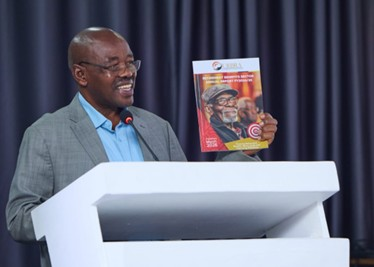
The Uganda Retirement Benefits Regulatory Authority (URBRA) on 5th March, released the Annual Sector Performance Report, indicating that sector assets had surged to Ugx30.7 trillion, a 21% increase from 25.4 trillion in FY2023/24. Similarly, the number of Ugandans saving for retirement has grown significantly, reaching 4,062,144, up from 3,224,529 in 2023/24.
Other key indicators reflect a thriving sector. Average interest credited to member accounts rose from 10.97% in 2023/24 to 14.6% in 2024/25 and the ratio of retirement savings to GDP from 12.2% to 13.6%.
While releasing the report at Fairway Hotel, the Minister of State for Planning, Hon. Amos Lugoloobi lauded URBRA for their supervisory efficiency, emphasising that a vibrant pensions sector contributes to the attainment of government’s ambitious ten-fold growth strategy.
“The Government of Uganda embarked on an ambitious agenda to expand Uganda’s economy from USD 50 billion to USD 500 billion by 2040 under the Ten-fold Growth Strategy. Achieving this transformation requires sustained growth of the Retirement Benefits Sector because retirement schemes account for 67% of gross domestic savings,” Hon. Lugoloobi said.
The continued sector growth is attributed to several factors key among them favourable macro-economic conditions, growing contributions from employers and employees, improved employer compliance, supervisory interventions and increased financial literacy.
Despite the positive trajectory, experts warn that the sector faces significant structural challenges that threaten its long-term viability.
At the macro level, demographic factors loom large. According to the Uganda Bureau of Statistics (UBOS) National Census report of 2024, Uganda’s population is 45.9 million. Life expectancy has improved to 68.2 years of age, with retirees living an average of 17 years. While the working age population is estimated at 26 million, existing retirement benefits arrangements cover only four million. The remaining 22 million are mostly informal sector workers including farmers, artisans, or those not engaged in any income generating activity. These factors don’t portend well for the sector.
Focusing on the citizens saving for retirement, sector experts observed that their future financial security is not guaranteed because of the paltry average individual balances, and ease of access to savings. Members typically receive their savings as a lumpsum, moreover they exit at an early age of 55 for private sector and 60 for public service. Mid-term access is permitted from age 45, and weak portability guidelines mean savings are cashed out when members change jobs. This all means that payouts are quickly outpacing contributions. According to the performance report, in FY2024/25, benefits paid increased by 16% to Ugx1.62 trillion, outpacing the 10% growth in contributions.
“For many schemes, members who are about to exit have big balances because they have served longer. But generally, the average member balance is still low at just Ugx8.2 million. This has implications for the long-term sustainability of the schemes and the sector,” Benjamin Mukiibi, URBRA’s head of research and strategy said.
For Mubbale Mugalya, General Manager Sanlam Allianz Investments, the issue is low productivity. He argued that productivity of Ugandans is too low to assure sector sustainability. From the retirement age perspective, Mugalya argued that people should remain active and productive to the oldest age possible.
“Why is our retirement age capped at 55 yet many countries are at 70?” he questioned, adding that an early retirement age means early exit from the scheme, yet people could continue working and saving well past the age of 55 or even 60. “When I look at my NSSF balance, the growth in the last three years is almost half of what I have accrued. If I continue saving up to age 60 maybe I will double the benefits,” Mugalya argued.
He also challenged the notion of post-retirement productivity, arguing that retirees’ skills are often misdirected. “If someone has 25 years of corporate experience, why should they turn to farming upon retirement? Retired people should be deployed where they serve best.” He extended the argument to Uganda’s workforce at large, citing the example of over three million boda-boda riders. “Is that the most productive they can be? Will they ride boda-bodas until they reach retirement age? How can their productivity be improved?” There is need to re-evaluate productivity at individual level.
Scheme operational costs are another area of concern. Operating expenses reached Ugx263 billion in FY2024/25, up from Ugx258 billion. Mukiibi flagged wasteful expenditures, including extravagant AGMs, high advertising costs, overseas staff retreats, tax penalties for non-compliance, and avoidable litigation costs. Some schemes, he noted, obscure expenses under vague categories like “other costs,” undermining transparency. “We are monitoring each scheme’s expenses against the interest declared to members,” he warned.
All these factors affect the sustainability of the retirement benefits sector and compromise the purpose of retirement saving which is to alleviate old age poverty. Stakeholders agree that addressing these challenges requires legal, regulatory, and policy interventions. URBRA is spearheading efforts to establish a National Long-Term Savings Scheme (NLTSS), designed specifically for informal sector workers. Meanwhile, the government is finalising the operationalisation of the Public Service Pension Fund, a defined contribution scheme intended to ensure sustainability and better outcomes for public servants.
Regarding scheme governance and compliance failures, there are imperatives that must be considered: trustees must take their roles more seriously and the scope of their liability should be expanded; schemes must optimise financial operations, reduce operating expenses to protect yields and apply the principles of full disclosure; enhance external audit independence by enforcing obligatory rotation of auditors; increase transparency through regular publication of detailed sector information; for prudent investment strategies, implement data-backed strategies focused on long term returns; apply rigorous risk decision analysis, especially when considering private equity and real estate.
As Uganda’s pension sector celebrates record growth, the message from regulator and other experts is clear: size alone is not success. Without urgent reforms to expand coverage, improve productivity, and curb inefficiencies, the promise of a dignified retirement will remain a distant dream for millions of Ugandans.