

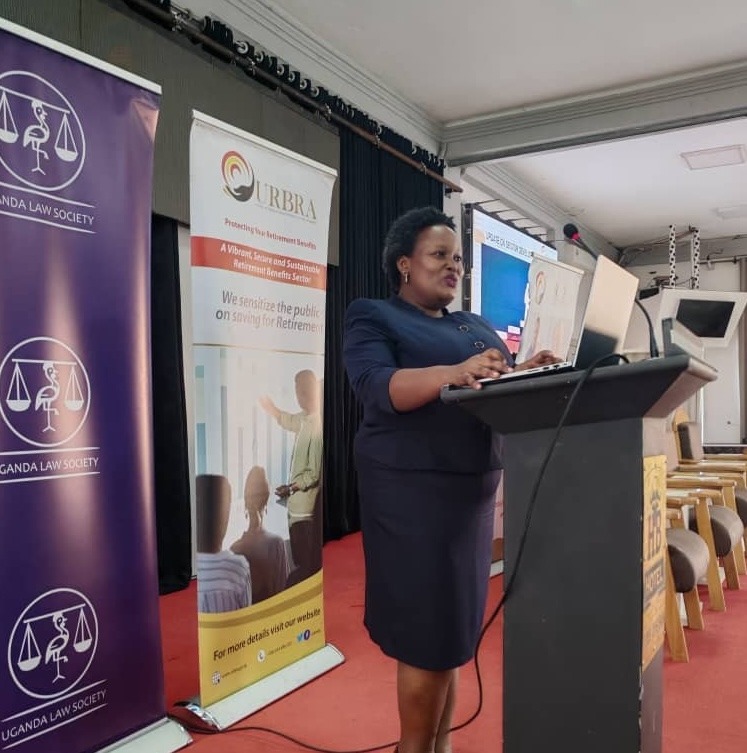
 For the past five years, the Uganda Retirement Benefits Regulatory Authority (URBRA) has partnered with the Uganda Law Society (ULS) to equip legal practitioners with knowledge and skills in Uganda’s Retirement Benefits Sector. What began as a professional sensitisation programme has evolved into an important platform for expanding legal practice, strengthening retirement planning and improving understanding of retirement benefits legal framework. Up to 675 advocates have since benefited from the programme which has so far covered Kabarole, Hoima, Mbarara, Masaka, Mbale, Jinja, Arua, Gulu and Kampala.
In FY 2025/26 alone, 140 practitioners were sensitised, enhancing their capacity to support compliance and member protection.
According to Doris Kahuura, Senior Legal Officer at URBRA, the initiative was designed with two objectives in mind: to expose lawyers to emerging opportunities within the retirement benefits sector and to contribute to their Continuous Legal Education (CLE).
“We wanted lawyers to understand the sector better and appreciate the different roles they can play not only as legal practitioners representing clients, but also as trustees, service providers and advisors involved in establishing and managing retirement benefit schemes,” she explains.
Over the years, the programme has introduced lawyers to developments in retirement benefits regulation while broadening their understanding of a sector that was previously unfamiliar to many practitioners.
One of the clearest signs of the programme’s impact is the growing number of retirement benefits cases now reaching URBRA through legal representatives.
“Previously, members would approach us directly,” Kahuura says. “Today, we are seeing more complaints being filed through law firms. It shows that lawyers are increasingly recognising retirement benefits as an area of legal practice.”
She believes the trend could eventually lead to greater specialisation in retirement benefits law, much like labour and employment law has evolved into a recognised field of legal practice.
Beyond professional practice, the sensitisation sessions are also encouraging lawyers to think more deliberately about their own financial futures.
During recent engagements in Hoima and Masaka, participants proposed the establishment of a provident fund for members of the Uganda Law Society to complement existing retirement savings arrangements. Although the proposal is still under discussion, Kahuura views it as evidence that the conversations are inspiring lawyers to take retirement planning more seriously.
The engagements have also highlighted challenges facing young lawyers, many of whom begin their careers without being enrolled in mandatory retirement savings arrangements.
“As young lawyers, many simply don’t know they should be asking about retirement benefits when they sign employment contracts,” she says. “If they understand their rights from the beginning of their careers, they will be better equipped to advocate for themselves.”
Looking ahead, URBRA intends to deepen its engagement with the legal fraternity by placing greater emphasis on advocacy. One priority will be encouraging stronger protection for lawyers and other professionals through proper employment contracts and compliance with mandatory retirement benefit contributions.
The Authority also plans to continue supporting discussions around the proposed Uganda Law Society provident fund while promoting retirement planning as an essential part of professional practice.
For Kahuura, the partnership between URBRA and the Uganda Law Society demonstrates the value of collaboration between professional bodies and regulators.
“Retirement benefits affect everyone,” she says. “When professional associations create opportunities for their members to access quality learning at no cost, they not only strengthen professional practice but also improve financial security for their members.”
As the programme enters its sixth year in 2026/27, URBRA hopes to build on the gains made so far by strengthening impact measurement, collecting participant feedback and ensuring more legal practitioners are equipped to support both their clients and their own retirement planning.