
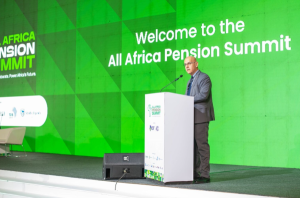
 Africa has enough long-term capital to finance its own future. This was the conviction shared by 650 delegates who gathered at Speke Resort Munyonyo, to attend the inaugural All Africa Pension Summit. Representing 31 African countries, the delegates generated ideas and charted ways of how African pensions and retirement savings can finance Africa’s development agenda.
Hosted by the National Social Security Fund (NSSF), the summit was premised on the realisation that for too long, Africa has depended on development aid, but this has not fully emancipated the continent from under-development. Rather, it has created permanent dependency and a huge debt burden. Moreover, most of the aid is lost in illegal financial flows and corruption.
The figures are staggeringly high: Africa’s Annual financing gap is USD1.3Tn; the annual infrastructure gap is USD200Bn; average foreign debt dependency is 68%. All this amidst a growing population which is projected to reach 2.5bn by 2050. These conditions create an urgent need for new financing solutions, otherwise the continent will never reach its ambitious development goals.
Unfortunately, the landscape of aid has fundamentally shifted. Despite remaining the biggest recipient of Official Development Aid (ODA) Africa’s share of ODA has dropped from 37.6% in 2013 to 26.7% in 2023 – and it continues to drop. The impact of the closure of USAID is yet to be fully assessed. This change is an opportunity to innovate and rely more on domestic resources.
“Africa is not short of resources — we’re short of mobilization. It’s time to look inward, to unlock the vast pools of domestic capital already within our economies,” NSSF Managing Director, Patrick Ayota said at the opening of the summit.
Re-echoing Ayota’s message, Leonard Zulu, the UN Resident Coordinator in Uganda said that Africa must look inward, mobilize domestic savings, diaspora remittances, and blended finance models to reduce aid dependency. “It is imperative to unlock domestic capital through various sources, including pension funds that have been growing rapidly in recent years,” Zulu said, giving the example of Uganda’s retirement benefits sector which is now worth Ugx25.4 trillion, an 18.6% increment from Ugx21.4 trillion in 2023. Zulu further recommended that it would also be prudent to unlock domestic capital from capital markets and innovative instruments such as insurance funds, patient and venture capital, green and infrastructure bonds, as well as remittances and diaspora investments.
Thus, the All-Africa Pension Summit laid a foundation for a continental discussion on how Africa’s US$ 1.3 Trillion pension assets could be strategically leveraged into transformation engines for inclusive growth, sustainable infrastructure, and social protection.
For President Museveni, the All Africa Pensions Summit was an opportunity to actualise the common expression of African solutions for African problems. In a speech read for him by Prime Minister Robina Nabbanja, President Museveni argued that of the four key factors of production, Africa has natural resources and labour and only lacks capital and entrepreneurship. He urged delegates to use the summit to address their minds to those outstanding factors.
The Minister of Gender Labour and Social Development, Betty Amongi implored pension funds to take up the mantle, not as charity but as a serious responsibility. She assured them that they had the power to change Africa’s destiny. Amongi decried the fact that Africa’s resources have been used to develop other economies, ignoring the continent’s own development needs.
But while conviction and desire met in the three-day summit, stakeholders raised some challenges that must be addressed for Africa Pension funds to rise to the occasion. The key challenge in Africa is the loss of resources in illegal financial flows. Cristina Duarte, Special Advisor on Africa to the UN Secretary General highlighted that in 2022 alone, ODA worth USD4.4 bn was disbursed, but USD15-18 of that was lost in illegal financial flows. “Illegal financial flows drain 3.4 times more money than official development aid provides, yet the focus remains on ODA while IFF goes unchecked,” Duarte lamented.
Thus, if pension funds are to be leveraged to foster Africa’s development, stakeholders must institute tight controls and strict regulatory regimes. Minister Amongin assured delegates that by harnessing the power of pension funds to invest in development, government would not jeopardise the citizens’ social security. “Let me be unequivocally clear: the government stands resolute in its commitment. We will not jeopardize the social security our citizens depend on. We are committed to robust regulatory frameworks, to transparency, and to ensuring that these vital pension funds not only remain solvent but grow stronger,” she said.
A key output of the summit was the Kampala Declaration of the All Africa Pension Summit, in which delegates acknowledged the urgent need to bridge Africa’s infrastructure financing gap while ensuring the retirement security of millions of African workers. They also noted the importance of partnerships between pension funds, development partners, and governments to unlock the transformative potential of pension capital. The Summit concluded with concrete commitments to key outcomes across four strategic pillars:
Coverage Extension & Patient Capital. Delegates committed to increase coverage to 25% by 2028, generating USD 15 billion in new savings. Uganda, under NSSF was specifically tasked to scale the SmartLife voluntary scheme as a continental case study; lead informal sector pilots targeting 500,000 new savers; integrate NIRA, URA, NSSF systems for seamless registration
Cross-Sector Partnerships, strengthening relationships between Development Finance Institutions (DFI) and pension funds; promoting blended finance for SMEs and aligning policy frameworks with private-sector execution, with the aim to establish regional co-investment vehicles functional by 2027.
Infrastructure Investment. Delegates committed to mobilise pension assets for domestic infrastructure; build pipelines in renewable energy, transport, housing and social infrastructure; and ensure alignment with national development plans. They committed to allocate 5% of pension assets to infrastructure by 2028.
Environment Social Governance (ESG) and Social Impact, with a focus on instituting annual ESG reporting from 2026; establishing a green infrastructure facility worth USD1bn; and unified ESG standards across Africa. By 2027, 15% of all pension portfolios will be ESG-classified. Uganda, under NSSF, will lead the development of common ESG reporting templates; Pilot Uganda’s Green Pension Investment Report with UNDP; and Integrate ESG into NSSF policy and national investment guidelines
The Kampala declaration affirmed the resolve to transform Africa’s pension funds into strategic engines for sustainable growth, linking long-term savings to long-term development.
As NSSF MD Patrick Ayota concluded: “For too long, we have looked outward for solutions, despite possessing abundant savings and investable assets. This summit charts a new course: African pension funds will become engines for African infrastructure, financing domestic development and prosperity.”